Stepper Gear Motors vs BLDC with Encoder: Which Delivers Better Positioning in Compact Designs?
-
 2026.06.22
-
Buying Guides


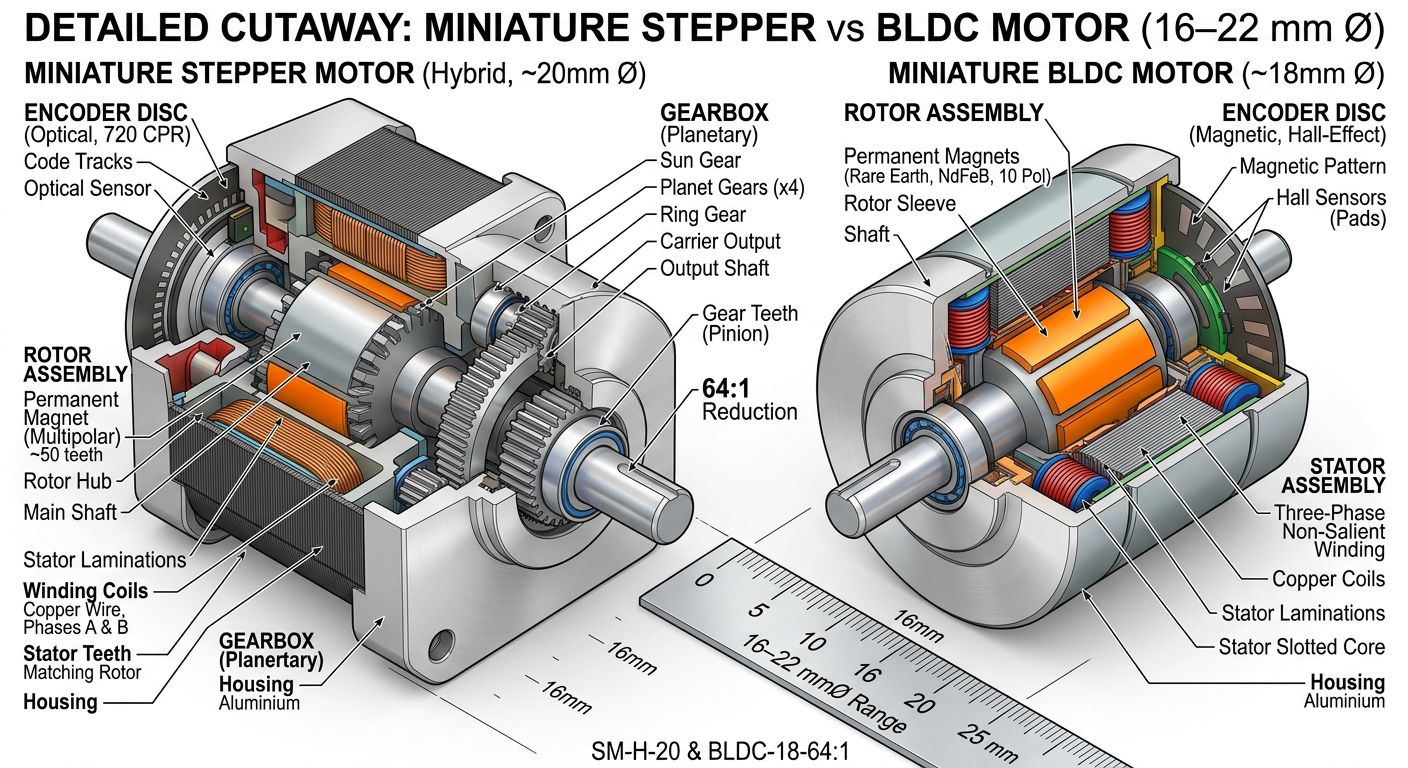
For most compact designs under 30 mm in diameter, a stepper gear motor delivers better positioning when motion is slow, indexed, and needs strong holding torque without a brake. A BLDC motor with encoder wins when you need smooth continuous motion, high efficiency, low heat at standstill, or sub-arcminute repeatability under load. The right answer depends less on raw accuracy and more on duty cycle, speed range, and how much driver complexity your product can absorb.
Below, we break the decision down by torque, resolution, thermal behavior, control complexity, and real OEM scenarios — so you can pick with confidence instead of defaulting to whatever you used last time.
The Short Answer: It’s a Duty-Cycle Decision
Forget the spec sheet for a second. The single biggest factor is how long the motor sits still versus how long it moves.
Stepper gear motors hold position by passing rated current through their windings — even when nothing is moving. That gives you rock-solid holding torque, but the motor heats up continuously. If your application parks the actuator for 80% of its cycle, a stepper will cook itself in a 20 mm housing.
BLDC with encoder is the opposite. At rest, a well-tuned servo loop draws near-zero current (assuming no external load fights it). Movement is where it spends energy. So if your duty cycle is mostly motion — pumps, fans with positioning, indexing wheels that never stop — BLDC stays cooler and lives longer.
Quick rule of thumb: stationary > 50% of the time and load is light? Lean BLDC. Stationary with constant external load (gravity, spring)? Stepper with self-locking gearbox, or BLDC with brake.
Positioning Resolution: Raw Numbers That Matter
This is where buyers often misjudge. A 1.8° stepper sounds coarse, but with a 50:1 planetary gearbox and 1/16 microstepping, planetary geared motors reach 0.00225° per step at the output shaft. That’s roughly 8 arcseconds — better than most encoders in this size class.
A typical compact BLDC with a 1,024 CPR optical encoder, after a 20:1 gearbox, gives you 0.0044° per count — about 16 arcseconds. With a 4,096 CPR absolute encoder, you drop below 1 arcsecond.
Effective resolution comparison
| Setup | Output resolution |
|---|---|
| 1.8° stepper, 1/16 microstep, 50:1 gearbox | ~0.0022° (8″) |
| 0.9° stepper, 1/32 microstep, 30:1 gearbox | ~0.0009° (3″) |
| BLDC + 1,024 CPR encoder, 20:1 gearbox | ~0.0044° (16″) |
| BLDC + 4,096 CPR absolute, 30:1 gearbox | ~0.0007° (2.5″) |
The catch: resolution is not accuracy. Microstepping gives you fine command positions, but actual torque-to-position linearity drops sharply between full steps. Real positional accuracy of a microstepped stepper is closer to ±5% of one full step regardless of microstep setting. BLDC with closed-loop feedback delivers accuracy that actually matches its counted resolution.
For background on encoder choices, see our guide on incremental, absolute, and Hall feedback.
Holding Torque: Where Steppers Quietly Dominate
Want to hold a 0.5 Nm load on a vertical axis with the power off? Pair a stepper with a worm or high-ratio planetary gearbox and you’re done. The detent torque alone — typically 5–10% of holding torque — often handles small loads without any current.
BLDC needs either an electromagnetic brake (adds 6–10 mm of length and cost) or continuous current with thermal penalty. In a 16 mm motor, that brake might not even fit.
For example, a small medical infusion mechanism we’ve specified for OEM customers needed to hold a syringe plunger against 8 N of back-pressure for hours between doses. A stepper with a 100:1 planetary held zero current and stayed at room temperature. A BLDC equivalent needed either a brake or a self-locking worm gearbox, which killed back-driveability needed for safety release.
Smoothness and Audible Noise
BLDC wins this round without much debate. Steppers have inherent step ripple — even at 1/256 microstepping, you can feel and hear it under 30 RPM. In quiet products (CPAP devices, lab instruments, premium camera gimbals) that ticking is a dealbreaker.
BLDC with sinusoidal field-oriented control (FOC) is essentially silent except for gearbox noise. If you’re already designing a low-noise enclosure, picking a stepper undoes a lot of that work.
A practical fix on the stepper side: closed-loop steppers (stepper + encoder + servo-like control) smooth things out and recover lost steps. They cost more than open-loop steppers but less than equivalent BLDC servos. Worth considering if smoothness matters but you still want stepper-style holding.
Thermal Behavior in Compact Housings
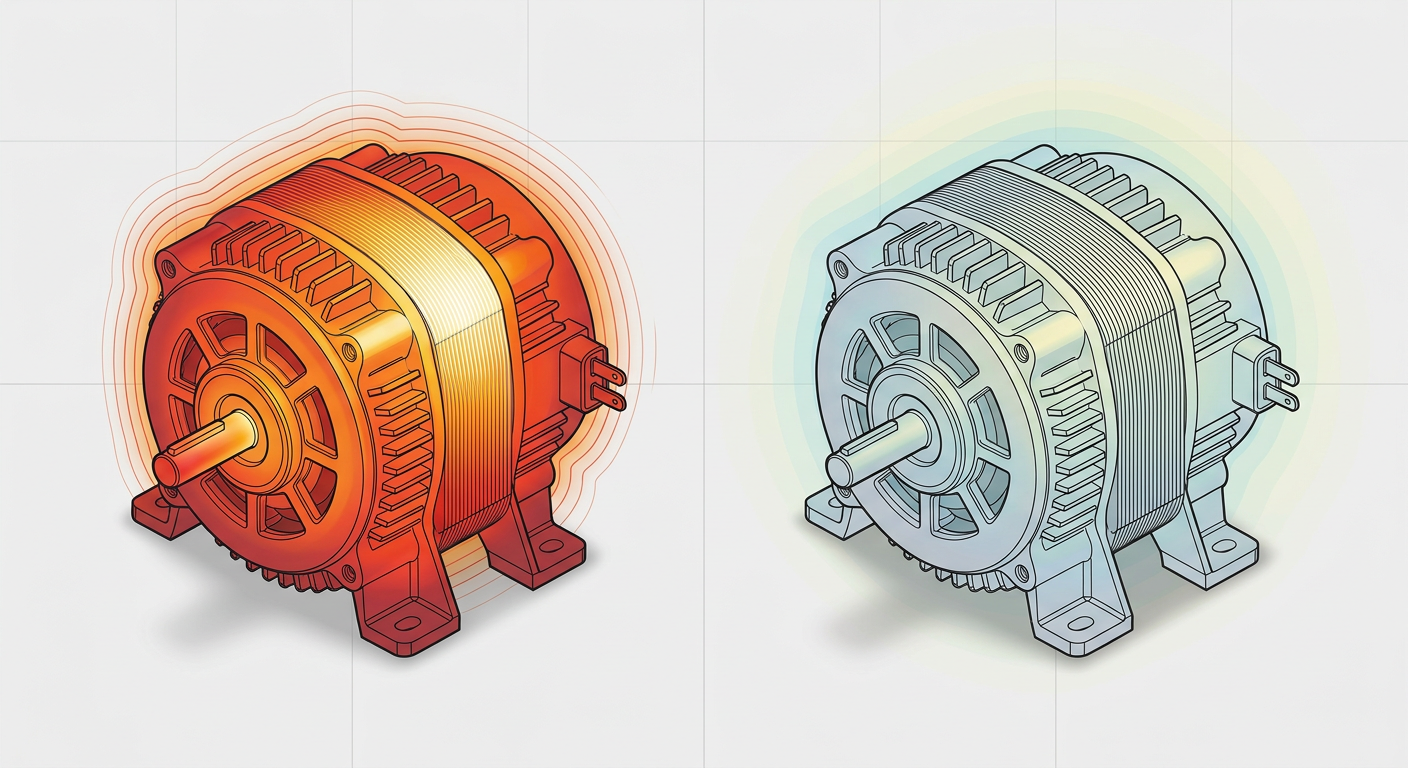
In a 20 mm motor envelope, you have maybe 2–3 W of continuous thermal headroom before insulation degrades. Steppers running at full holding current can easily push 4–6 W at rest. That’s why so many micro-stepper designs fail in the field: the motor works on the bench, then the customer mounts it inside a sealed plastic housing.
BLDC at standstill, properly tuned, sits at maybe 0.2–0.5 W (cogging compensation only). During motion, the higher efficiency (75–90% vs. 40–60% for steppers) means less waste heat per unit of work done.
If your product has a sealed enclosure or sits in a warm environment (vending machine sun exposure, in-cabin automotive, surgical light heads), the thermal math usually pushes you toward BLDC. For more on heat-related failures, see why micro gear motors overheat.
Driver Complexity and BOM Cost
Steppers are forgiving. A 2-dollar TMC2208 or similar driver gives you smooth microstepping with step/direction inputs. Your MCU just generates pulses. No tuning, no commutation, no feedback loop. For a small OEM team, that’s huge.
BLDC with encoder demands an FOC-capable driver, current sensing, commutation tables (Hall or encoder-based), and PID tuning. Off-the-shelf modules exist (STSPIN32, TMC4671, custom MCU firmware), but expect 2–4 extra weeks of firmware work for a first-time integration.
Rough BOM at 1k units
- Stepper gear motor + driver: ~$8–15 motor + $2–4 driver
- BLDC + encoder + FOC driver: ~$15–28 motor+encoder + $4–8 driver
The price gap shrinks if you’re already running a BLDC fan or pump elsewhere in the product — shared driver IP amortizes nicely.
Speed Range: A Quiet Disqualifier for Steppers
Compact steppers lose torque fast above 500–1,000 RPM. Even with high-voltage drivers, you’ll struggle past 1,500 RPM in a 16 mm package. After a 30:1 gearbox, that’s 33–50 RPM output. Fine for indexing. Useless for anything that needs to slew quickly.
BLDC happily runs 5,000–10,000 RPM in the same envelope. Same 30:1 gearbox gives 165–330 RPM output with full torque available throughout. If your application needs both fast travel and precise stops — pick-and-place heads, focus mechanisms, robotic finger joints — BLDC is the obvious choice.
For instance, a service robot wrist joint we recently helped spec needed 180°/second slew speed with ±0.1° final position. A stepper couldn’t slew that fast in a 22 mm envelope. A BLDC with encoder and a 50:1 planetary nailed it. More on that kind of service robot joint specification if you’re working on similar designs.
Two Real OEM Scenarios
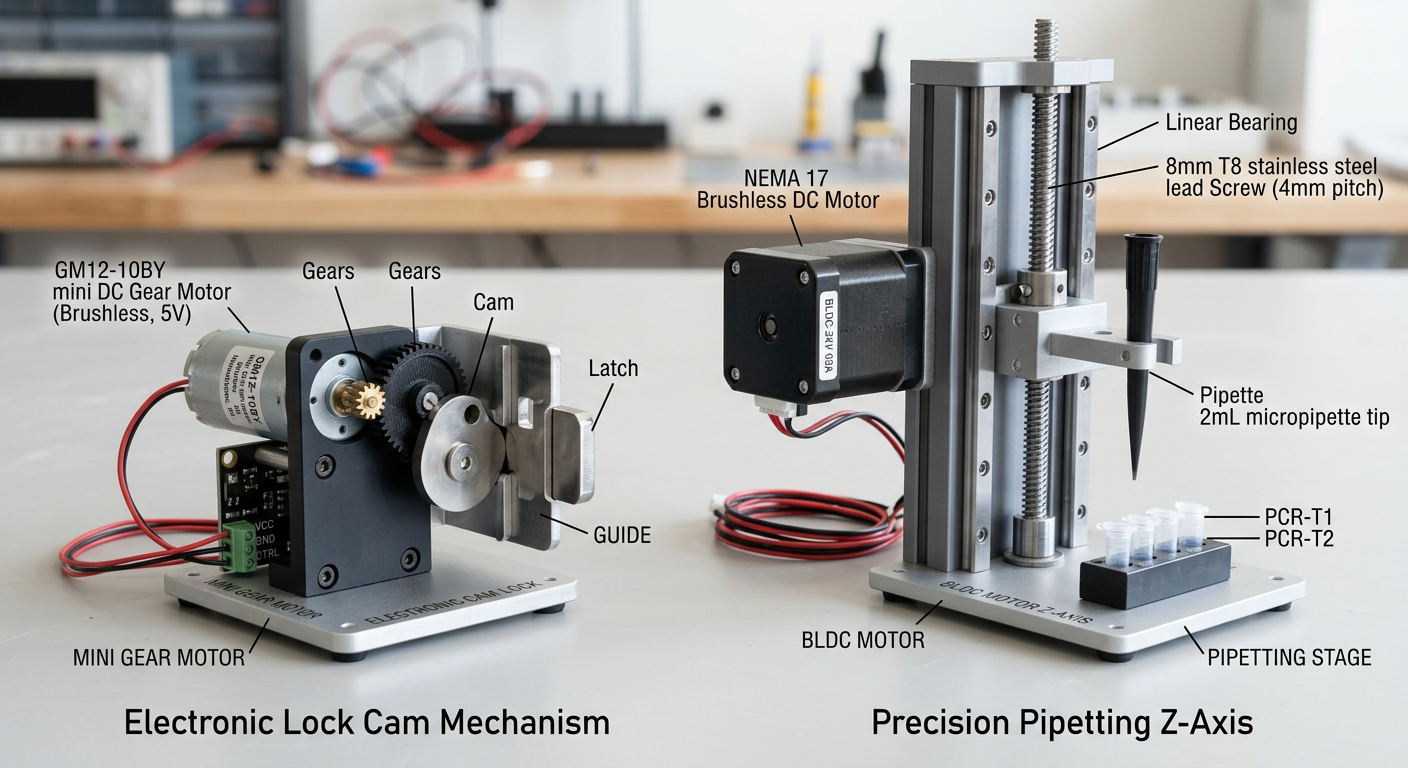
Scenario A: Smart lock cam driver
Cycles maybe 30 times per day. Needs to hold the cam against a return spring (2 N load) for 0.5 seconds during unlock. Sealed plastic housing, battery-powered, 6 V.
Pick: Stepper gear motor with 50:1 planetary. Open-loop, no encoder needed. Detent torque holds the cam between cycles. Driver is dirt simple. Battery life acceptable because duty cycle is < 0.1%. Our stepper gear motors are built for exactly this kind of low-duty-cycle holding application.
Scenario B: Lab pipetting head Z-axis
Continuously moves up and down 8 hours a day, 300+ cycles per hour, needs ±20 µm positioning at the tip, must be near-silent for clean-room use.
Pick: BLDC + encoder with 14:1 planetary and ball screw. Smooth motion, low heat under continuous duty, encoder feedback closes the loop on actual position. Stepper would overheat and click audibly.
When a Closed-Loop Stepper Is the Right Compromise
Don’t overlook the middle ground. A closed-loop stepper (stepper + encoder + servo controller) gives you:
- Stepper’s strong holding torque without continuous full current — the controller reduces current at rest
- BLDC-style position recovery if you stall
- Smoother motion than open-loop microstepping
- Simpler tuning than a full BLDC servo
Cost lands between the two extremes. For mid-volume products where the engineering team doesn’t want to invest in full FOC firmware but still needs reliability, this is often the sweet spot. We’ve seen this pattern win on automated dispensers and small CNC accessories.
Quick Decision Checklist
Run through these before you commit to a topology:
- Is motion < 20% of duty cycle? → Stepper, possibly with current reduction at rest
- Need smooth motion below 30 RPM? → BLDC + encoder, or closed-loop stepper
- Sealed housing, ambient > 40 °C? → BLDC + encoder
- Battery-powered, low cycles per day? → Stepper with self-locking gearing
- Output speed needed > 200 RPM? → BLDC + encoder
- Sub-arcminute repeatable accuracy under load? → BLDC + absolute encoder
- Limited firmware budget, simple step/dir control desired? → Stepper
If you’re still torn, check the torque and speed specs you must verify before buying — running real load numbers usually settles the debate.
Picking the Right Partner for Compact Positioning
Neither topology is universally better — and any vendor who says otherwise hasn’t built enough products. Steppers shine in slow, sticky, sleep-most-of-the-time mechanisms. BLDC with encoder owns the dynamic, smooth, thermally constrained corner of the design space. Closed-loop steppers split the difference when budget and complexity push back.
At SLW Motor, we build both — miniature stepper gear motors from 6 mm up, such as our 8 mm stepper motor with a 10 mm gearbox, and BLDC motors with integrated incremental, absolute, or Hall encoders, paired with planetary, spur, or worm gearboxes to match your torque and footprint.
If you’d like a sanity check on your spec, or a sample to bench-test against your real load, send us your requirements and we’ll come back with two or three configurations worth comparing. You can also browse our compact motor product range to see what fits your envelope.