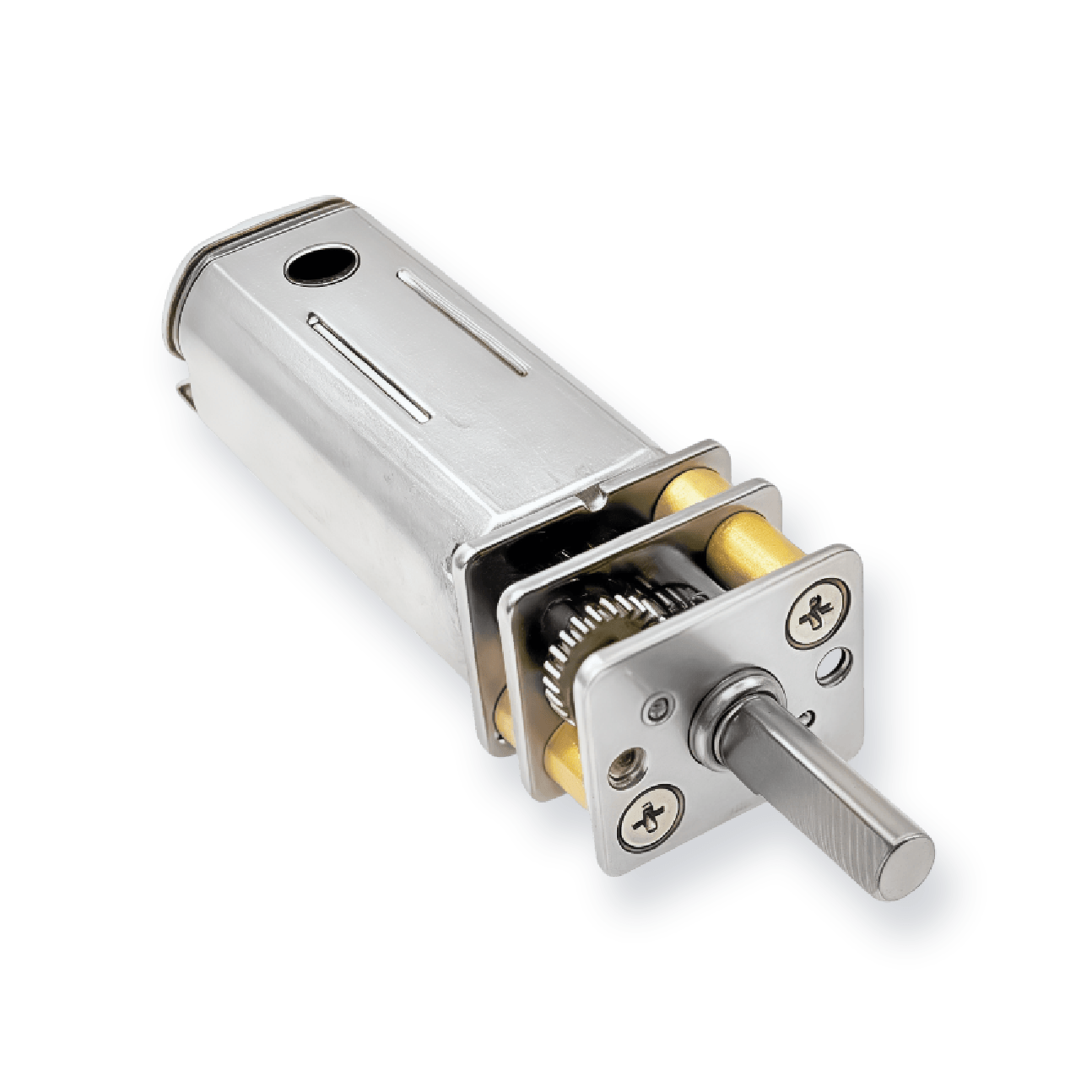
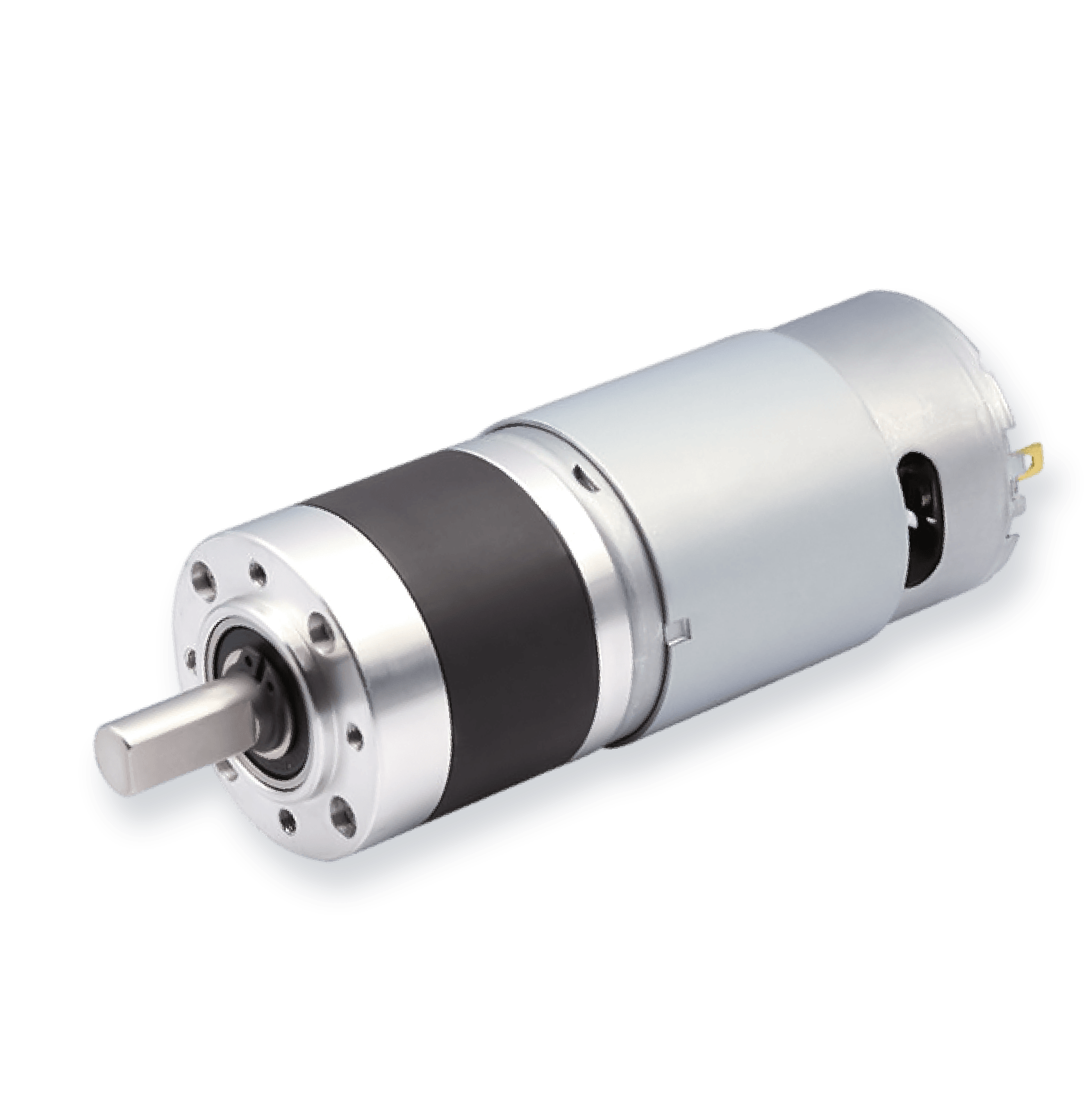
How to Spec a Micro Gear Motor for a Service Robot Joint
-
 2026.06.18
-
Design Guides


Speccing a micro gear motor for a service robot joint comes down to five numbers you must lock down before anything else: peak joint torque, holding torque, joint speed under load, backlash tolerance, and continuous current at your duty cycle. Nail those, and the rest — gearbox type, encoder resolution, voltage rail, motor topology — falls into place naturally. The mistake we see most often? Engineers pick a motor first, then try to make the joint work around it. Do it the other way.
Start From the Joint, Not the Motor
Every joint has a job. A shoulder lifts a payload. A wrist orients an end effector. A neck pans a camera. Each generates a torque profile you can calculate before you ever look at a motor catalog.
Write down three things for the joint:
- Static torque — torque needed to hold the arm in its worst-case pose (usually fully extended, horizontal).
- Dynamic torque — torque needed to accelerate the joint at your target angular acceleration.
- Peak transient torque — what happens during a collision, emergency stop, or unexpected payload contact.
For a typical 600 mm service robot arm carrying a 500 g payload at the wrist, the shoulder joint sees roughly 3 Nm static and 4–5 Nm peak. The wrist itself only needs 0.2–0.4 Nm. Same robot, two completely different motors. If you want a refresher on what numbers actually matter at this stage, our guide on torque and speed specs to check before buying a motor walks through the calculation in detail.
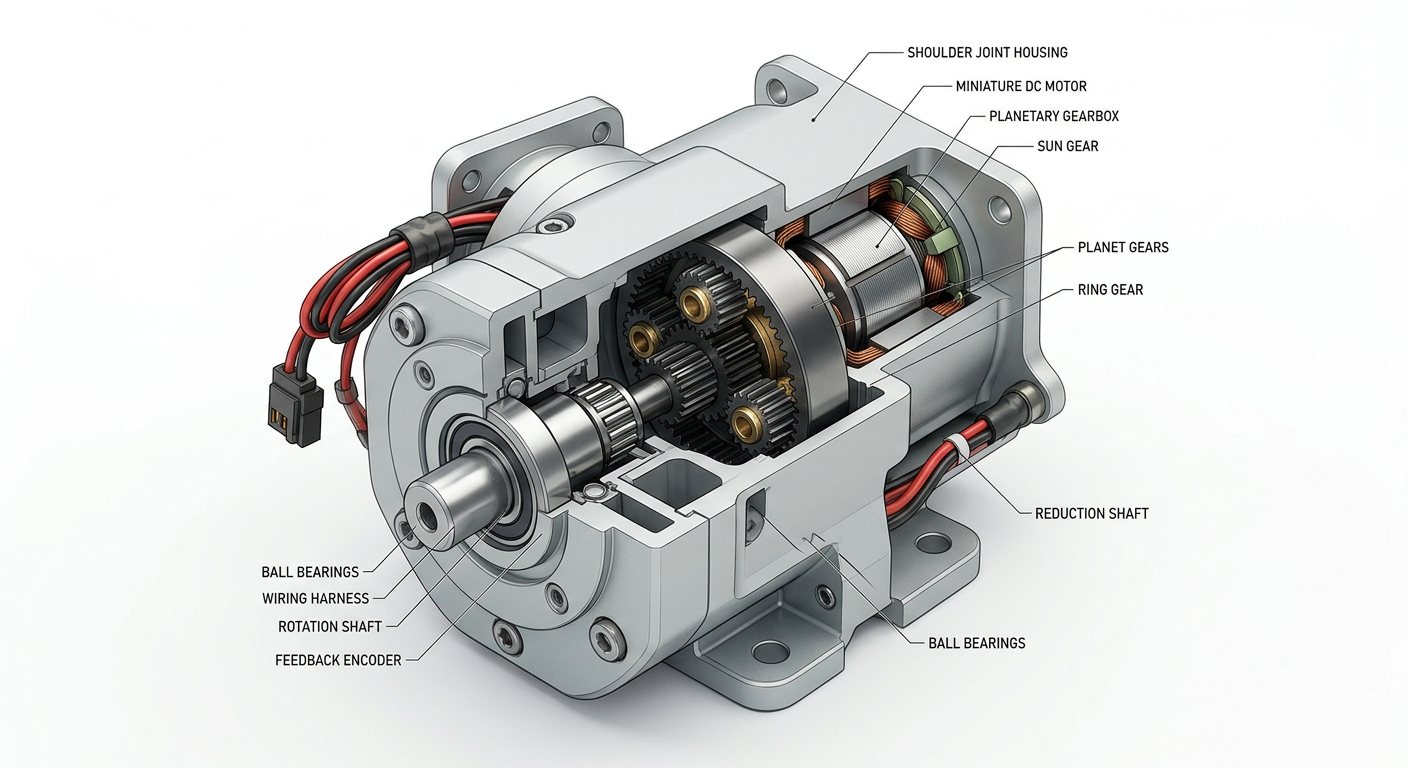
Pick the Gearbox Type Before the Motor
The gearbox decides the personality of the joint. The motor just supplies the energy.
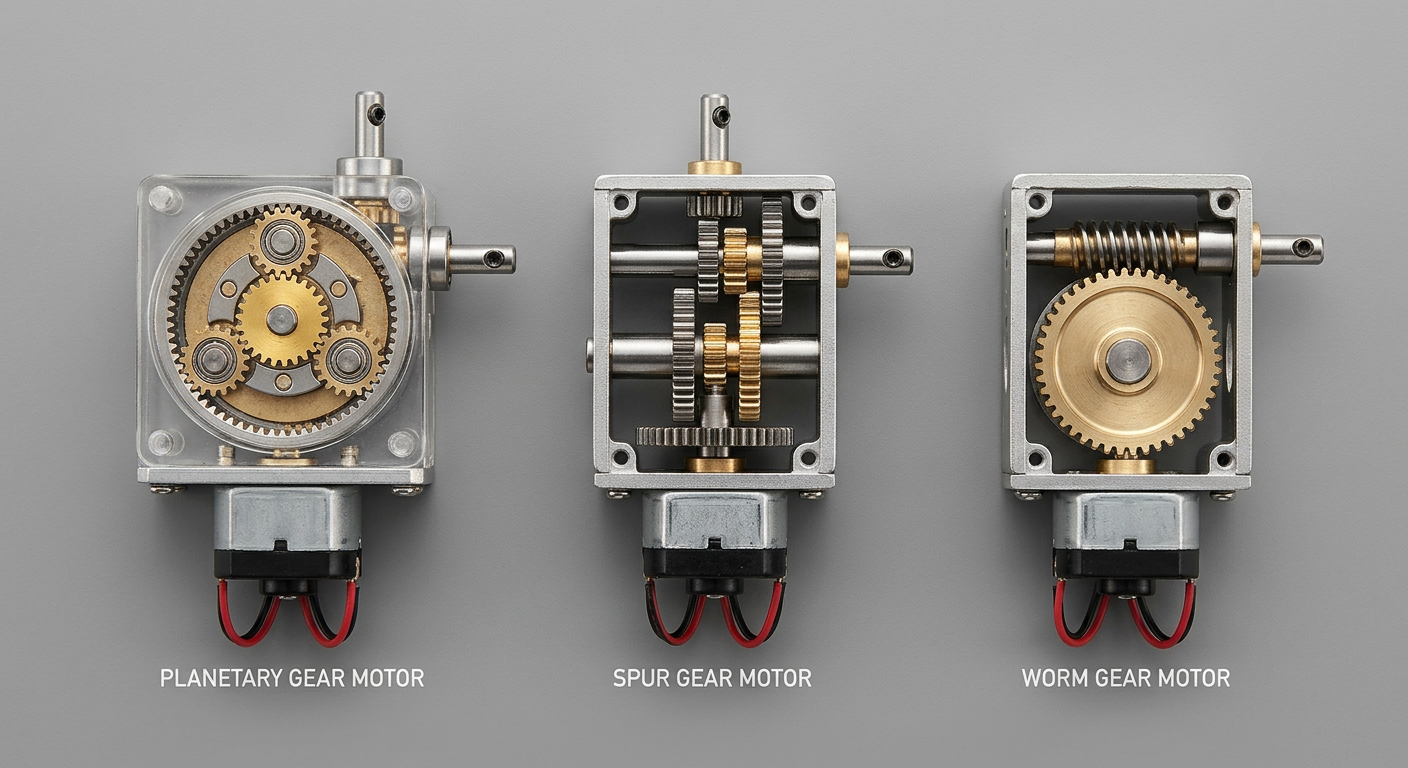
Planetary — the default for robot joints
For most service robot arm and leg joints, a planetary gear motor is the right answer. High torque density, 80–90% efficiency, backlash as low as 8–15 arc-minutes on precision grades, and a coaxial output that fits cleanly inside tubular joint housings. A 16–22 mm planetary stack handles 90% of small service robot applications.
Spur — for cost-sensitive low-load joints
Spur gear motors work for grippers, finger joints, and low-torque pan motions. They’re cheaper and easier to source, but backlash typically sits in the 30–60 arc-minute range. Fine for open-loop or low-precision tasks, not for closed-loop positioning under 1°.
Worm — when you need self-locking
Worm gears self-lock, which means the joint holds position with zero motor current. That’s gold for a camera tilt head or a kiosk arm that parks in a fixed pose for hours. The trade-off is efficiency — often below 60% — and you can’t back-drive. We dig deeper into this in planetary vs spur vs worm gearboxes.
Calculate the Gear Ratio Properly
Gear ratio is where many designs go wrong. Engineers pick a ratio that gives the right torque at stall and discover later that the joint moves at a crawl.
Work the math from both ends:
- From torque: required joint torque ÷ motor stall torque × gearbox efficiency = minimum ratio.
- From speed: motor no-load RPM ÷ required joint RPM = maximum ratio.
Your usable ratio lives between those two numbers. For example, if your joint needs 3 Nm at 60 RPM, and you’re considering a 12 V brushed coreless motor with 8 mNm continuous torque at 8,000 RPM no-load, the math points to roughly 100:1 — well within reach of a two- or three-stage planetary head with around 80% efficiency.
One rule of thumb: leave 30–50% torque headroom. Motors that run constantly near their rated torque operate with less margin for acceleration, load variation, and gearbox losses. For a worked calculation covering torque, speed, efficiency, safety factors, and reduction ratio, see our guide on how to calculate torque and gear ratio for a small linear actuator.
Choose the Motor Topology That Matches the Duty Cycle
Three motor types dominate service robot joints. The choice depends on how the joint actually runs.
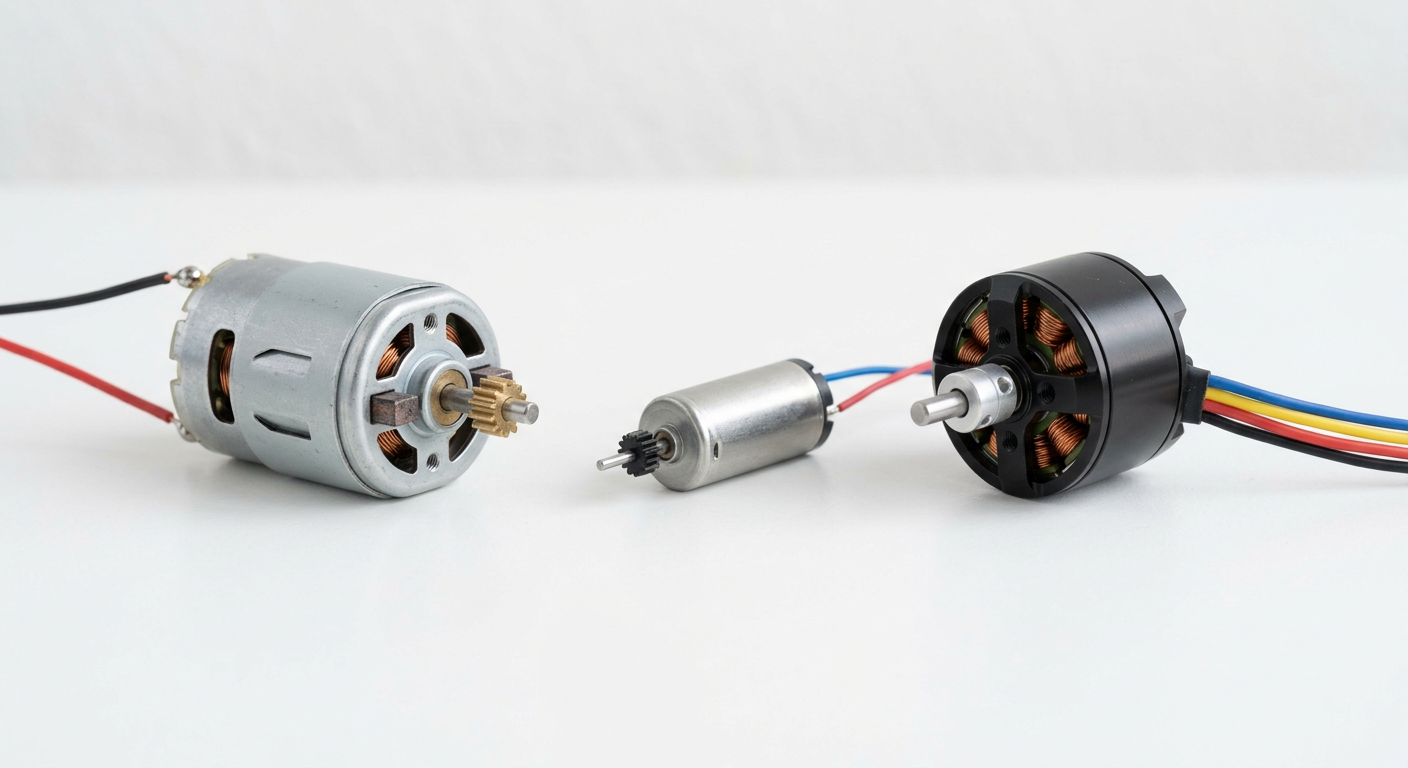
Brushed DC with iron core
Cheap, simple, fine for intermittent motion. Brush life caps useful service at roughly 1,000–3,000 hours. Good for vending mechanisms or low-cycle joints. Wrong for arms that move all day.
Coreless brushed DC
Almost no rotor inertia, snappy response, excellent efficiency at low load. Ideal for finger joints, surgical-style tools, and lightweight wrists where the motor starts and stops thousands of times per hour — exactly what compact coreless motors are built for. Limited continuous torque, though. Our piece on coreless DC motors in battery-powered devices goes into the trade-offs.
Brushless DC (BLDC)
The default for any joint that runs continuously, needs long life (10,000+ hours), or carries meaningful payload. Frameless and slotted BLDC motors in the 16–36 mm range now hit torque densities that were premium-only a few years ago. If the robot is service-grade and operates 8+ hours a day, BLDC is almost always the right answer. Still unsure? Compare them head-to-head in brushed vs brushless DC motors.
Match the Encoder to the Control Loop
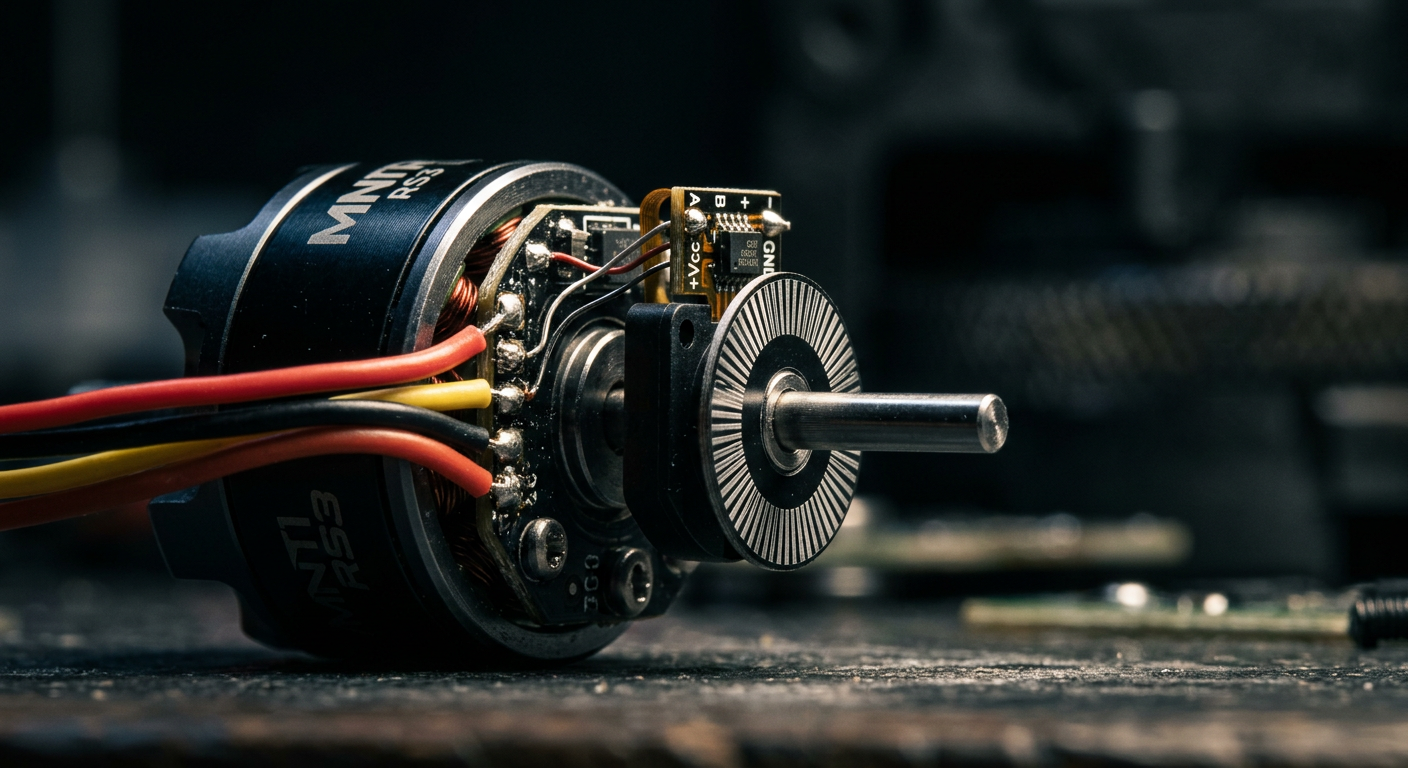
The encoder isn’t a checkbox. It defines how precisely you can position the joint and how smoothly the controller can run.
- Hall sensors only — fine for velocity control of a continuously rotating joint (a sweeping camera, for instance). Resolution is too coarse for positioning.
- Incremental optical or magnetic, 500–2,048 PPR — the workhorse for most service robot joints. Combined with a 100:1 planetary gearbox, you get effective resolution well under 0.01° at the output.
- Absolute encoder — required if the joint must know its position at power-on without a homing sequence. Common on collaborative arms and any joint that can’t safely sweep through a homing arc.
One real example: an OEM building a tabletop pharmacy-dispensing robot picked Hall-only feedback to save cost. The joints overshot pick targets by 1–2 mm because the controller couldn’t resolve position finely enough. Switching to a 1,024 PPR magnetic encoder fixed it without changing motors. Our deep dive on encoder feedback types covers when each makes sense.
Budget the Backlash, or Pay For It Later
Backlash is the dead zone where the motor turns but the joint doesn’t. Add up the backlash across every stage — gearbox, coupling, any belt or pulley — and that’s your worst-case positioning error.
For a service robot arm pouring liquid into a cup, 30 arc-minutes of backlash at a shoulder joint translates to about 5 mm of position uncertainty at a 600 mm reach. The arm will look shaky to a customer even if the controller is perfect. Spec a low-backlash planetary head (under 15 arc-minutes) for the first two joints, and you can usually relax the spec on the last joints near the end effector.
If standard catalog backlash specs don’t fit the joint’s positioning budget, that’s often the signal to consider a custom gearbox rather than chasing a workaround in software.
Size the Voltage, Current, and Thermal Envelope
Service robots usually run from a battery, which constrains the voltage rail. 12 V, 24 V, and 36 V are the most common picks.
Higher voltage gives you headroom for fast acceleration without exceeding current limits. Lower voltage simplifies wiring and battery management. For most arm joints in service robots, 24 V is the sweet spot — enough rail voltage for snappy motion, low enough for safe touch-handled designs.
Then check continuous current at your duty cycle. A motor rated for 2 A continuous can typically handle 4–6 A in short bursts, but only if average current stays within the thermal limit. If the joint moves 30% of the time, you can size for a higher peak. If it’s holding torque against gravity continuously, you need to size for that holding current — not the rated continuous current at no load.
Thermal performance also depends on load, duty cycle, current draw, ventilation, and gearbox efficiency. If the prototype runs hotter than expected, review why micro gear motors overheat and the practical fixes before changing the motor or gearbox specification.
Don’t Forget Mechanical Integration
The best-specced motor still fails if it doesn’t fit the joint housing. A few details that trip up first-time robot designers:
- Output shaft type — D-shaft is fine for clamp couplings, but for high-torque joints you want a keyed or splined output, or a flange-mount face on the gearbox.
- Radial and axial load on the output bearing — joints with belt or cable drives pull sideways. Check the manufacturer’s load curves; a small planetary output bearing typically handles 20–60 N radial.
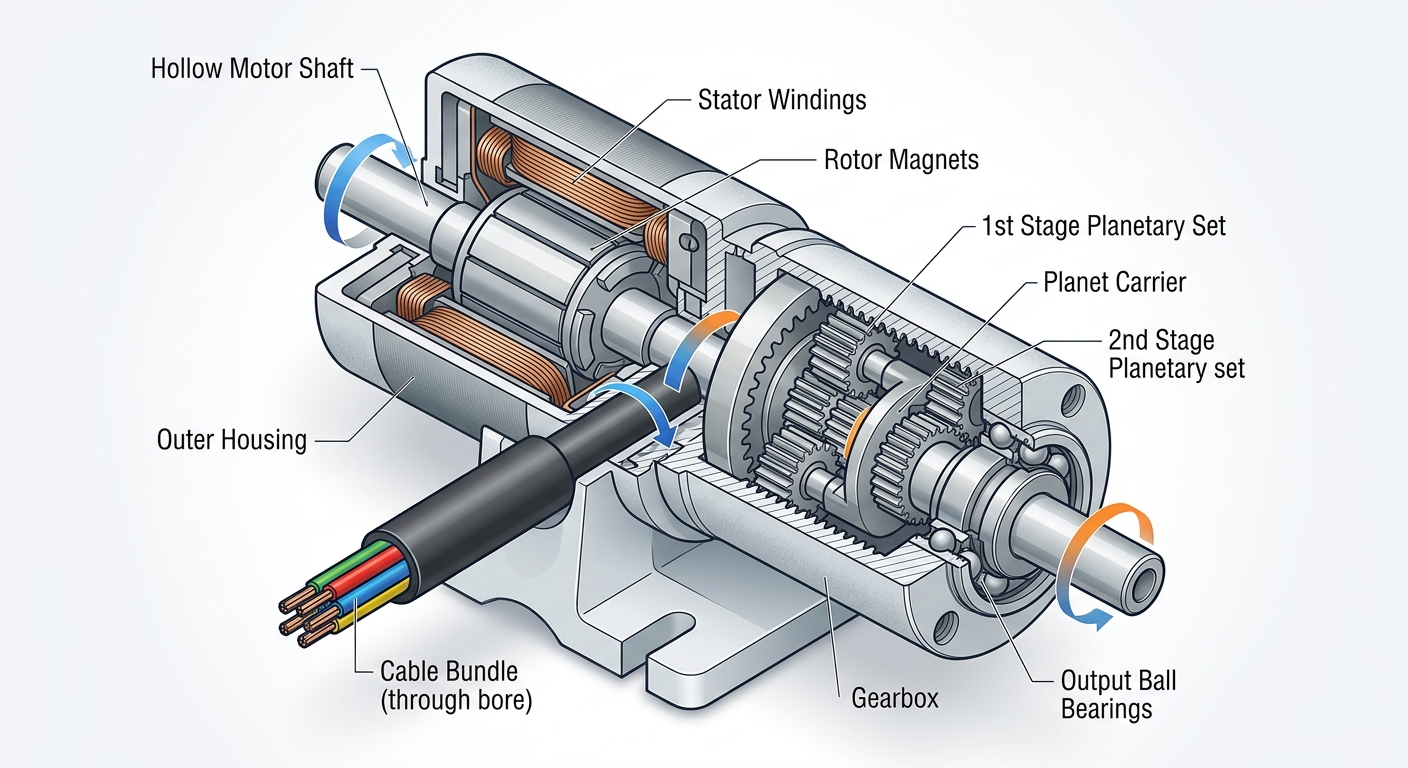
- Cable routing for encoder and motor leads — through-bore designs help for joints that need to pass wires through the rotation axis.
- Mounting orientation — some gear motors have lubrication that migrates in vertical orientations. Always confirm with the supplier.
For example, a hospitality robot OEM we worked with selected a 22 mm BLDC planetary motor with a hollow shaft to route the gripper cable through the wrist joint. It saved 40 mm of arm length and eliminated a cable management arm — the kind of integration win that only happens when mechanical and electrical specs are decided together.
Putting It Together: A Worked Example
Let’s spec the elbow joint of a 500 mm service robot arm carrying a 400 g payload.
- Static torque needed — 0.4 kg × 0.3 m (effective lever from elbow) × 9.81 ≈ 1.2 Nm. Add 50% safety margin → 1.8 Nm.
- Joint speed — 90°/s = 15 RPM.
- Backlash budget — 0.5 mm at end effector → ~20 arc-minutes at the joint.
- Duty cycle — 50%, with 5–10 motion cycles per minute.
- Power — 24 V battery system.
Candidate solution: a 22 mm BLDC motor with around 12 mNm continuous torque at 5,000 RPM, paired with a two-stage planetary gearbox at 81:1 (efficiency ~85%). Output torque ≈ 12 × 81 × 0.85 = 825 mNm continuous, with 2–3 Nm peak — comfortably above the 1.8 Nm requirement. Output speed ≈ 62 RPM, four times the target, leaving plenty of acceleration headroom. Add a 1,024 PPR magnetic encoder for closed-loop control. Done.
That’s the entire workflow in one paragraph. It works for almost any service robot joint you’ll spec.
Where to Go From Here
Speccing a robot joint motor is a sequence, not a single decision: define the joint torque and speed, pick the gearbox type, calculate the ratio with headroom, choose the motor topology that matches the duty cycle, then layer on encoder, voltage, and mechanical integration. Get the order right and the catalog selection becomes obvious.
If you’re working through a joint design and want a second pair of eyes on the numbers — or you’ve outgrown standard catalog parts and need a tailored gearbox or encoder configuration — the engineering team at SLW Motor works with OEM robotics teams every week to get this right. Share your torque curve and duty cycle, and we’ll come back with two or three candidate configurations from our miniature motor and gear motor catalog, or quote a custom build if that’s what the joint really needs. Get in touch with the joint requirements and we’ll take it from there.