Encoder Motors Explained: Incremental, Absolute, and Hall Feedback — Which One Fits Your Application?
-
 2026.06.15
-
Technology


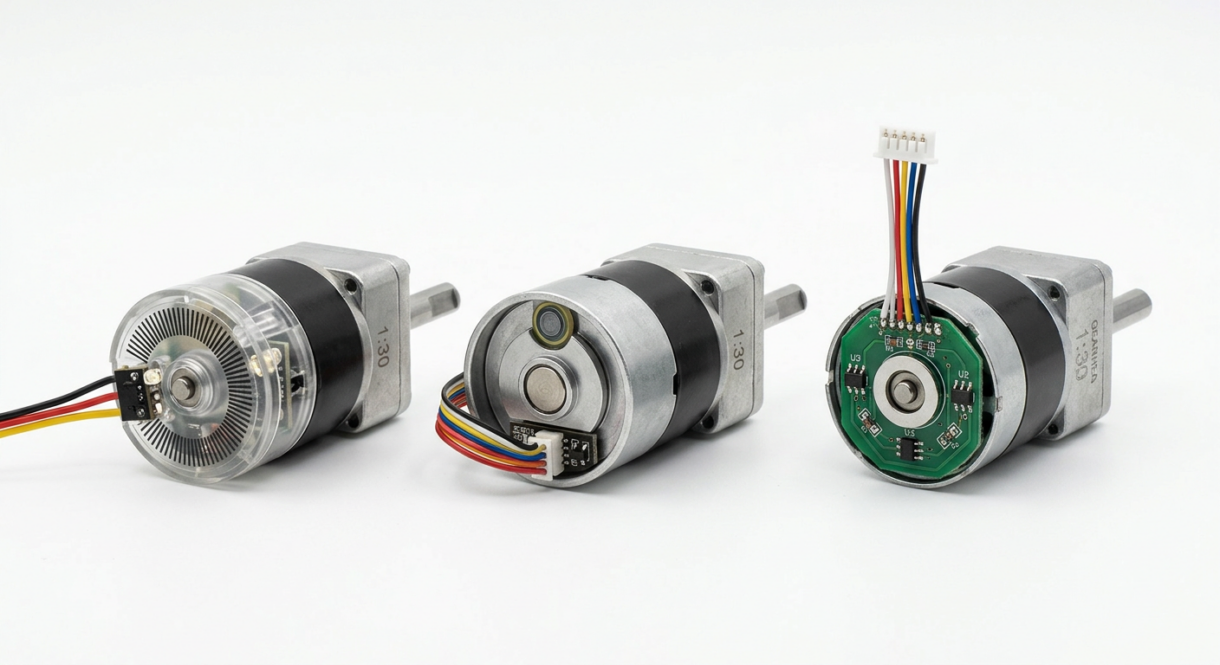
If you need precise speed or position feedback from a compact motor, the choice is simple: use Hall sensors for low-cost BLDC commutation, incremental encoders for high-resolution speed and relative position counting, and absolute encoders when the system must know exactly where it is the instant power comes back on. Each type trades off cost, resolution, wiring complexity, and power-cycle behavior — and picking the wrong one usually shows up as homing routines you didn’t budget for, jitter you can’t tune out, or BOM cost you can’t justify.
The Three Feedback Types in One Minute
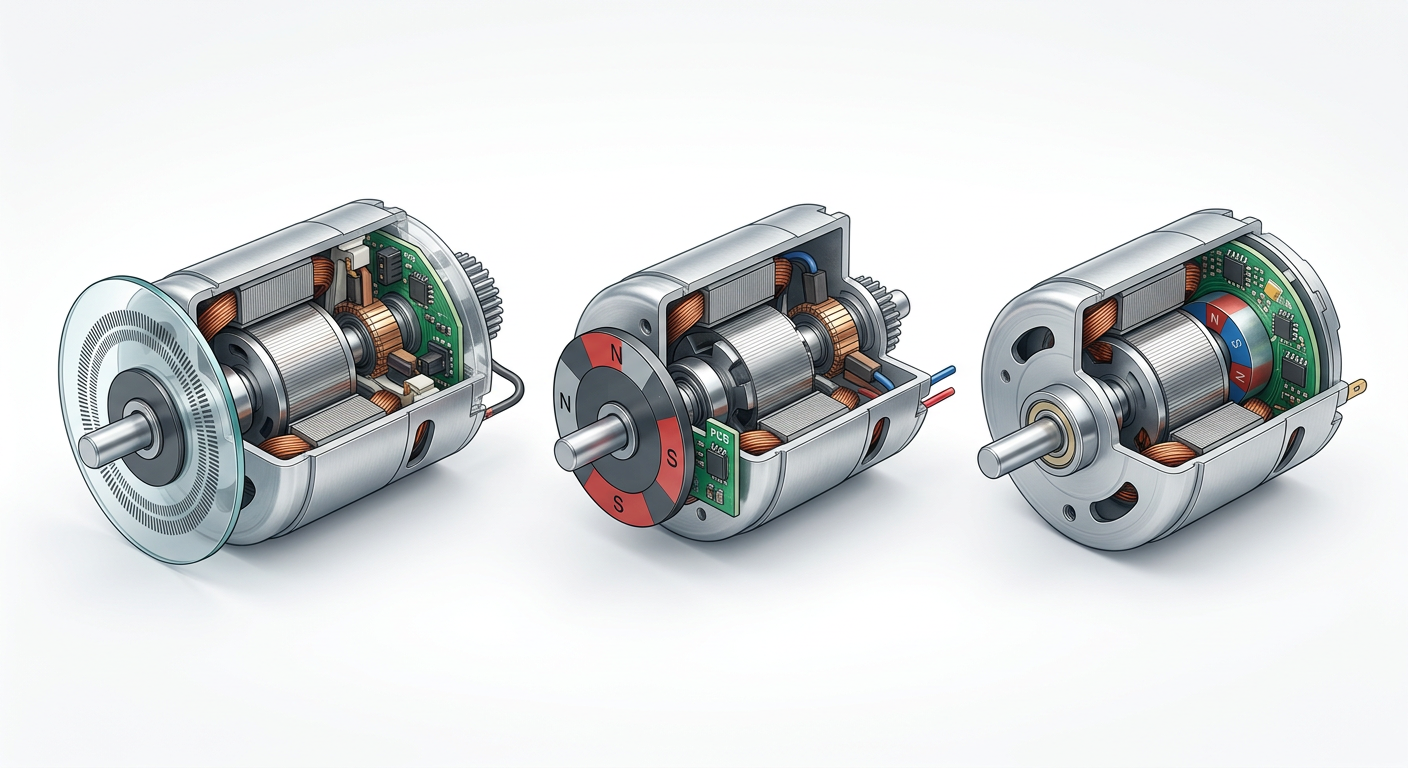
Before we go deep, here’s the short version. An incremental encoder outputs pulses as the shaft turns — your controller counts edges to figure out position and speed. An absolute encoder outputs a unique digital code for every shaft angle, so the controller always knows the exact position, even right after power-up. Hall effect sensors are simpler still: they detect the magnetic poles of the rotor and tell a BLDC driver when to switch phases.
The catch? Those one-line descriptions hide important real-world tradeoffs. Incremental encoders lose their position memory the moment power drops. Absolute encoders cost two to five times more. Hall sensors are too coarse for anything beyond commutation and rough speed estimation. The right choice depends on what your application actually demands — not on which sounds most impressive on a datasheet.
Incremental Encoders: The Workhorse of Compact Motion
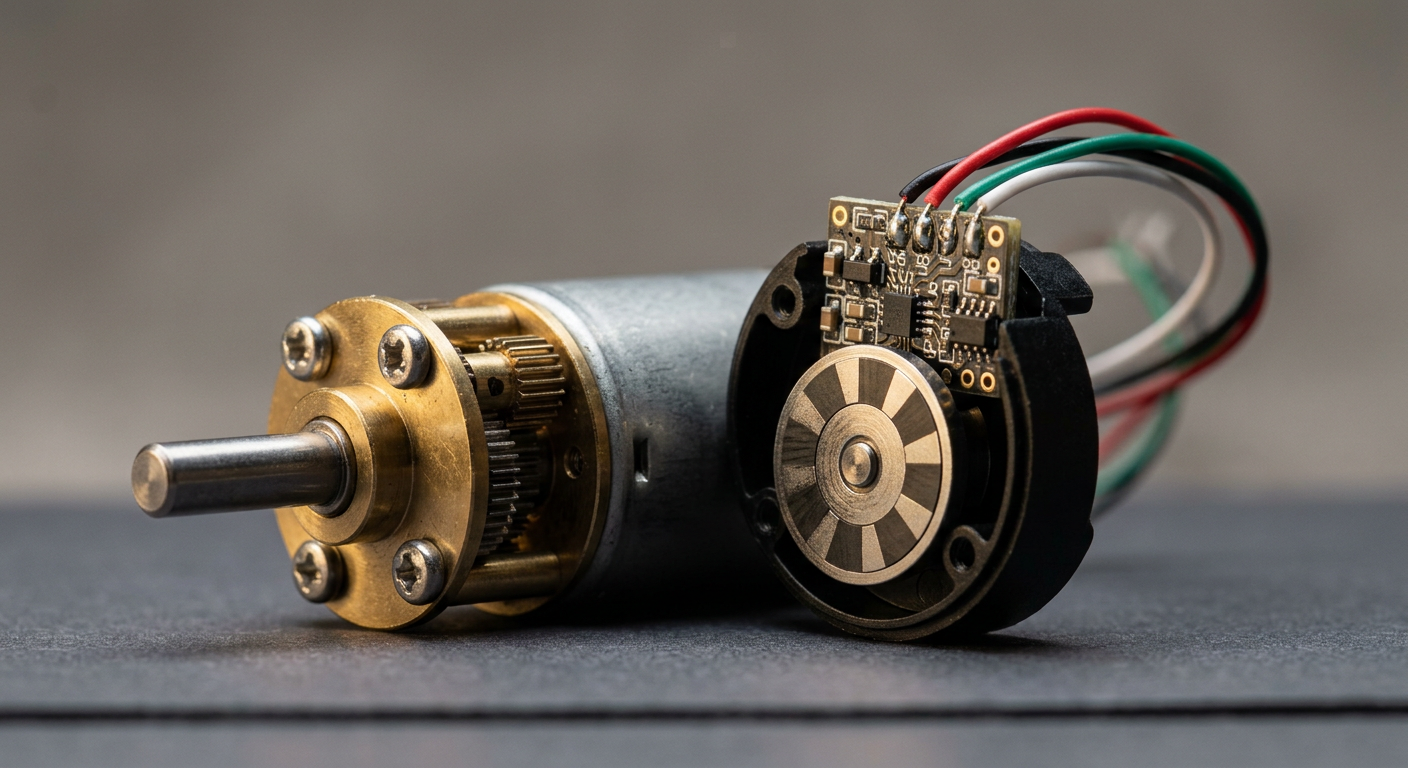
Incremental encoders are the default choice for a reason — they deliver high resolution at low cost and integrate cleanly with almost any microcontroller. A typical compact encoder motor uses a magnetic or optical encoder mounted on the rear shaft, outputting two square-wave channels (A and B) that are 90 degrees out of phase. By counting edges and watching which channel leads, your controller knows direction, speed, and relative position.
Resolution and Quadrature Counting
A 500 CPR (counts per revolution) encoder in 4x quadrature mode actually gives you 2000 counts per shaft rotation. Pair that with a 100:1 planetary gearbox and you suddenly have 200,000 counts per output revolution — more than enough for most positioning tasks in robotics or lab automation.
Where Incremental Encoders Shine
- Closed-loop speed control on conveyors, pumps, and fans
- Mobile robot wheel odometry
- Camera gimbals and pan-tilt heads
- Lab dosing pumps and small linear actuators
For example, a benchtop 3D bioprinter we worked with used a 12 mm coreless DC motor with a 512 CPR magnetic encoder driving a lead screw. The team didn’t need absolute position — they ran a homing routine against an optical endstop at startup, and incremental feedback handled everything from there. Total feedback cost: under three dollars per axis.
The One Real Limitation
Lose power, lose position. Every startup needs a homing sequence, which means an endstop switch, a known reference, and a few seconds of initialization time. If that’s a dealbreaker, keep reading.
Absolute Encoders: When Position Memory Is Non-Negotiable
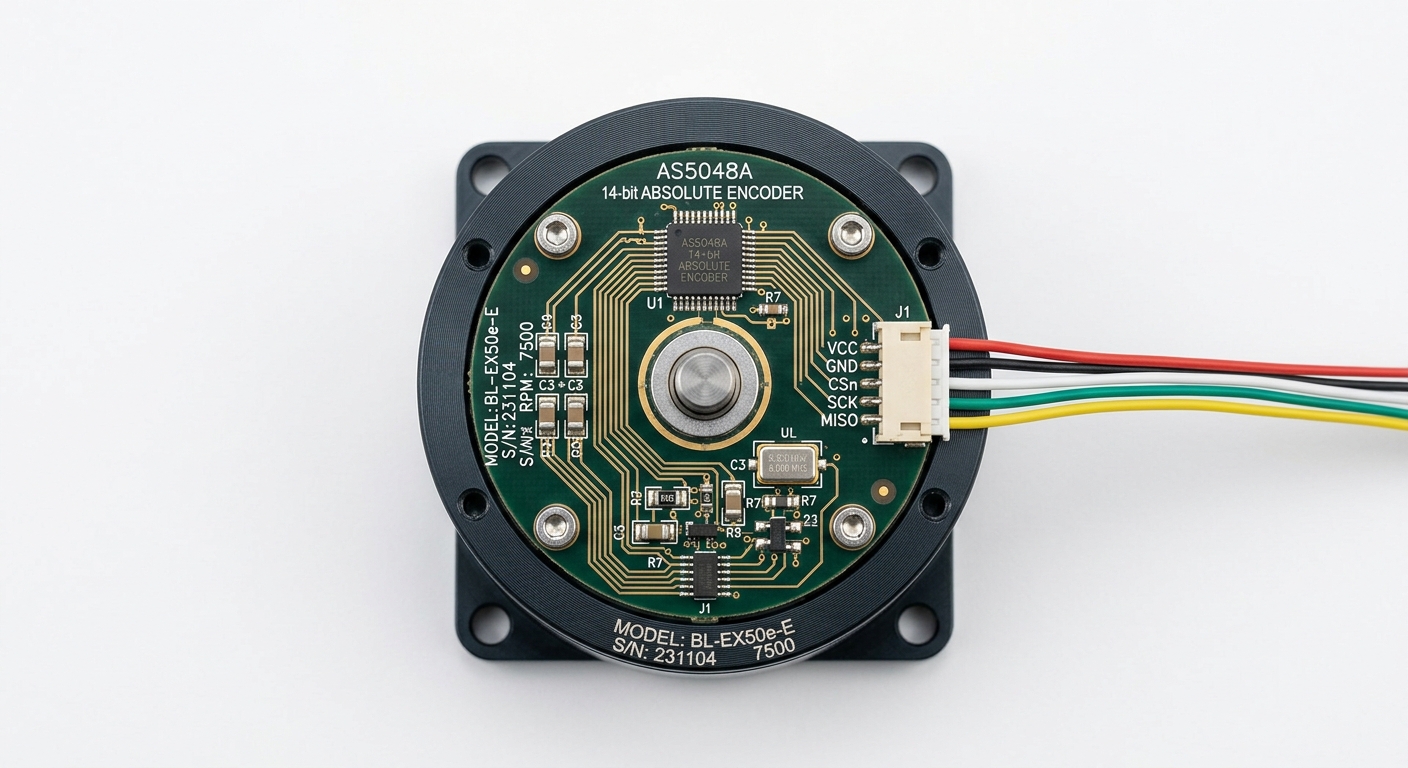
Absolute encoders solve the homing problem by assigning every shaft angle its own unique digital code. Power up the system after a blackout, a battery swap, or an emergency stop — the encoder immediately reports the exact angle. No reference moves, no endstop crashes, no recalibration.
Single-Turn vs Multi-Turn
Single-turn absolute encoders give unique positions within one rotation (typically 10–14 bit, so 1024 to 16384 distinct positions). Multi-turn versions add a gear or battery-backed counter to track full revolutions — useful for lead-screw applications where the output moves several turns between travel limits.
Communication Protocols
Absolute encoders rarely use simple A/B pulses. Instead, expect serial protocols like SSI, BiSS-C, SPI, or sometimes I2C on compact magnetic absolute encoders (AS5048, AS5600-class chips). That means a bit more firmware effort, but the wiring is often cleaner — three or four wires instead of six.
Real-World Fit
Surgical robotic arms, infusion pumps, valve actuators, and antenna positioners all benefit from absolute feedback. Imagine an automated medication dispenser that loses mains power overnight — when staff turn it back on, the carousel must know exactly which slot is aligned, instantly, without a homing dance that might crash into a half-loaded cartridge. That’s an absolute encoder problem.
If you’re sizing the whole drivetrain at the same time, our guide on torque and speed specs to check before buying a motor pairs well with this discussion — encoder choice and mechanical sizing should happen together, not in sequence.
Hall Effect Sensors: Simple, Rugged, BLDC-Friendly
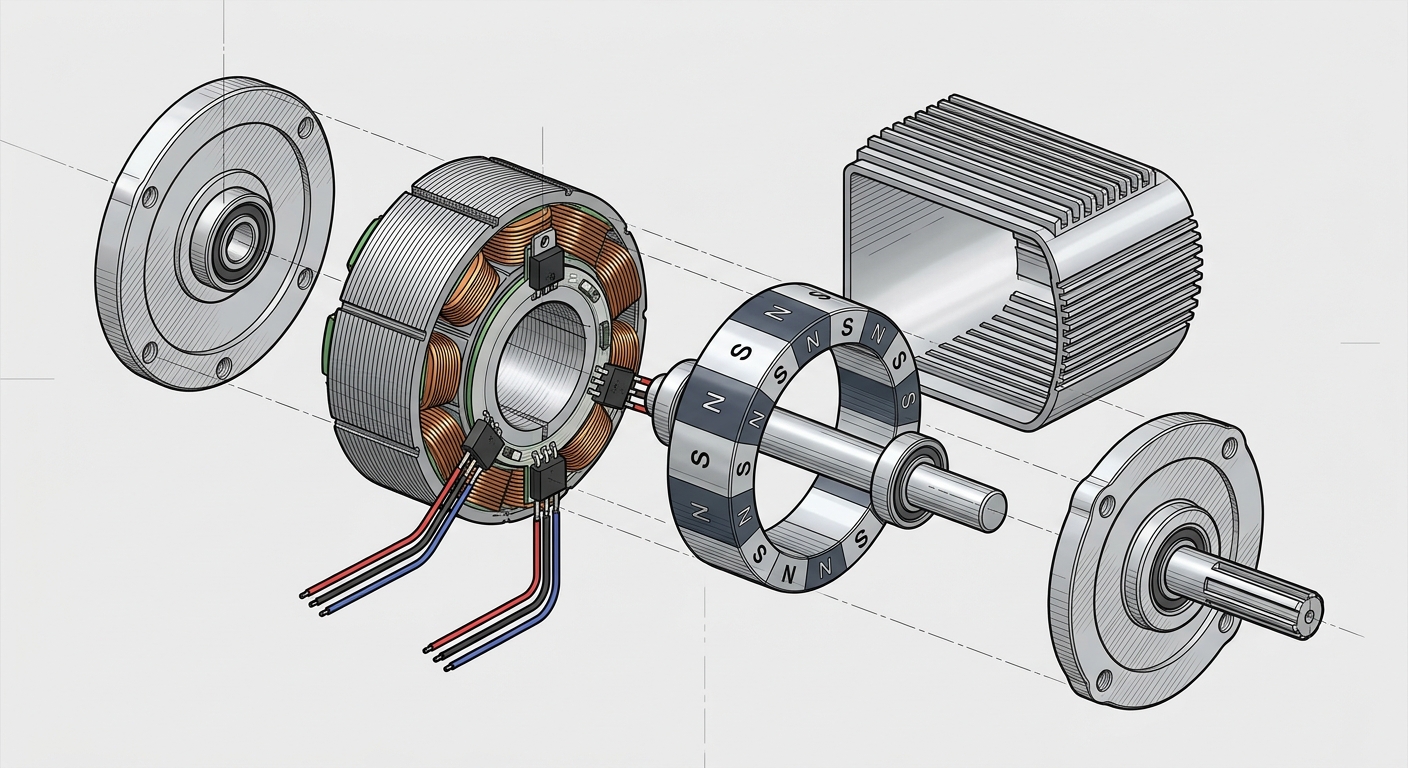
Hall sensors aren’t really “encoders” in the strict sense — they detect the magnetic field of the BLDC rotor and tell the driver when to commutate. A typical 3-phase BLDC motor uses three Hall sensors spaced 120 electrical degrees apart, giving six unique state transitions per electrical cycle.
What Hall Feedback Can Do
- Commutate a BLDC motor reliably from zero speed (unlike sensorless BEMF schemes)
- Provide coarse speed feedback — usable for fans, blowers, and simple wheel drives
- Detect direction of rotation
- Survive dust, oil, and vibration that would kill an optical encoder
What It Cannot Do
A 4-pole-pair BLDC motor with Hall sensors gives you 24 state changes per mechanical revolution. That’s it. Try to position-control with that and you’ll get visible stepping. Try to run a smooth low-speed velocity loop and you’ll see chunky torque ripple.
When Halls Are Enough
Power tool motors, e-bike hub motors, and cordless drill drivers almost universally use Hall-only feedback. So do many cooling fans and small pump motors. If your application needs robust commutation and rough RPM regulation — but not precise positioning — Halls are the cheapest, simplest answer. To decide whether you even need a BLDC in the first place, our breakdown on brushed vs brushless DC motors is a good starting point.
Hybrid Approaches: Combining Hall Plus Encoder
Here’s something many engineers miss — you don’t have to pick just one. Plenty of compact BLDC servo motors use Hall sensors for commutation startup and an incremental encoder for precise position and velocity control. The Halls handle the “which phase do I energize right now” question from a dead stop, while the encoder feeds the position loop.
Some designs go further: Hall sensors for backup commutation, plus a high-resolution absolute encoder for the control loop. If the encoder communication ever fails, the motor can still limp along on Hall commutation rather than locking up entirely. That kind of graceful degradation matters in medical and aerospace-adjacent equipment.
When to Choose Hybrid
- Servo positioning with smooth startup from any rotor angle
- Systems where fault tolerance is a hard requirement
- Wide-speed-range applications that need both low-speed precision and high-speed efficiency
The downside is wiring complexity and cost. You’re adding sensors, signal lines, and firmware logic. For a simple fan or a one-direction conveyor, it’s overkill. For a robotic gripper joint, it’s often exactly right.
Resolution, Accuracy, and Repeatability — Don’t Confuse Them
These three specs get mixed up constantly, and the difference matters when you’re sizing an encoder motor.
Resolution
The smallest position increment the encoder can report. A 4096 CPR encoder in quadrature mode resolves to about 0.022 degrees per count. Bigger number, finer resolution.
Accuracy
How close the reported position is to the true mechanical angle. A high-resolution encoder can still be inaccurate if the disc is eccentric, the magnetic poles are unevenly spaced, or the sensor is misaligned. Typical magnetic absolute encoders for compact motors hit ±0.5° to ±1° accuracy out of the box.
Repeatability
If you command the motor to position X ten times in a row, how tightly do the actual positions cluster? Repeatability is usually better than absolute accuracy and is often what really matters for OEM machinery — a pick-and-place arm doesn’t care if it’s 0.3° off in absolute terms, as long as it lands in the same spot every cycle.
Buyer tip: a 12-bit absolute magnetic encoder claiming 4096 positions per revolution may only be accurate to ±0.5°, while repeatability is 0.05°. Read the datasheet carefully, and ask the supplier which number your application actually depends on.
Matching Feedback Type to Application — A Practical Cheat Sheet
Here’s how I’d actually decide in a real project review:
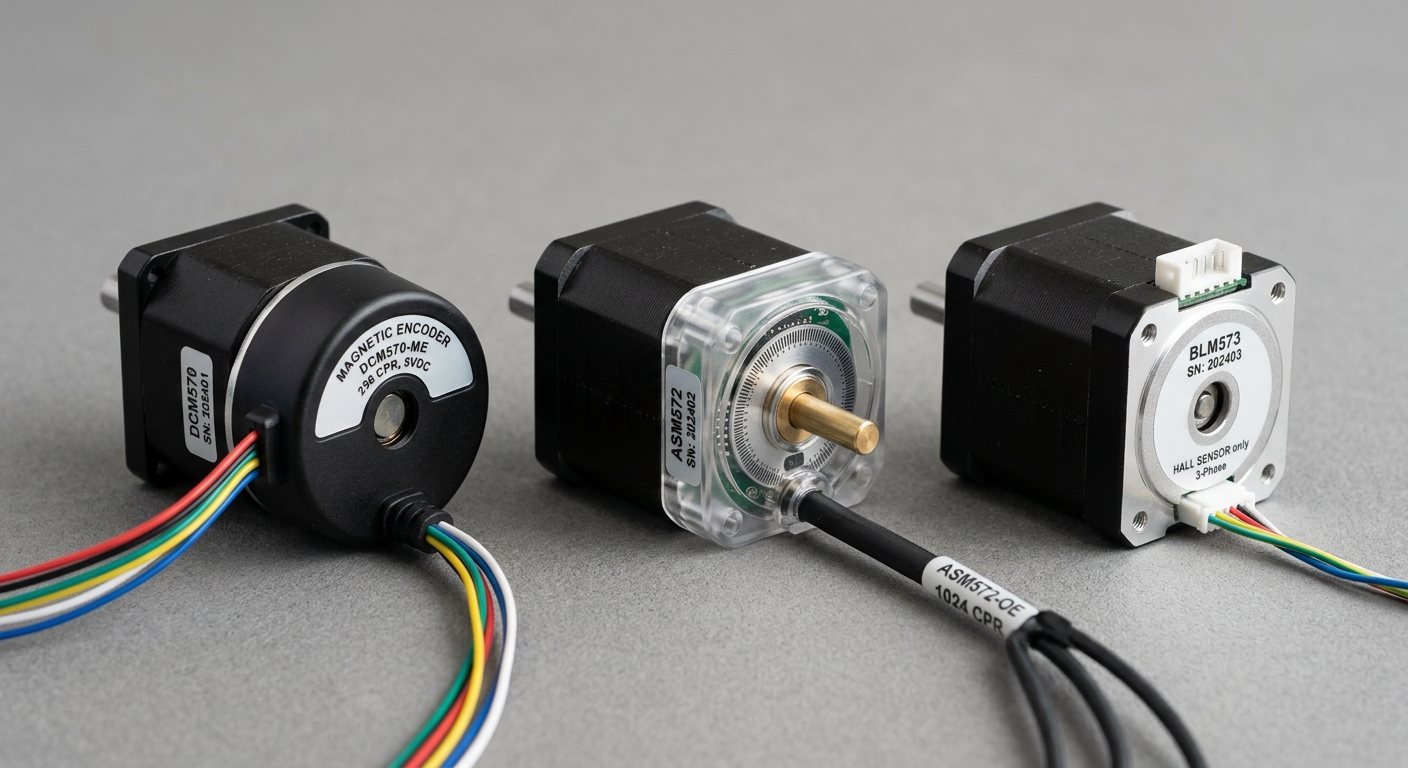
- Brushed DC gear motor driving a peristaltic pump — Incremental encoder. You need flow rate (speed) precision, and a homing routine isn’t needed because position doesn’t matter.
- BLDC motor in a cordless screwdriver — Hall sensors only. Commutation, torque sensing via current, done.
- Robotic finger joint on a prosthetic hand — Absolute encoder. Patient powers it on and the hand must already know its grip posture.
- Pan-tilt camera for an inspection drone — Hybrid Hall + incremental. Smooth pointing, low jitter, and lightweight wiring.
- Small linear actuator with travel limits — Incremental encoder plus endstop switches. Cheap, reliable, and homing on startup is fine.
- Surgical tool with a planetary gearhead — Absolute encoder. No homing, deterministic startup, fault tolerance.
If the gearbox choice is still open, our comparison of planetary, spur, and worm gearboxes can help you align the mechanical side with your feedback strategy — for instance, worm gearboxes give you self-locking without needing absolute encoder memory in some hold-position applications.
OEM Buying Considerations: Specs That Actually Matter
When you’re sourcing encoder motors at scale, the headline resolution number is rarely the deciding factor. Look harder at:
Signal Output Type
Open-collector, push-pull, or line-driver (RS-422)? Long cable runs in noisy industrial environments need differential signaling. Short runs inside a sealed product can use push-pull just fine.
Operating Temperature
Magnetic encoders typically rate from -40°C to +125°C. Optical encoders are often narrower (-20°C to +85°C) and don’t love condensation. For outdoor or under-hood applications, magnetic wins almost every time.
Mechanical Integration
How is the encoder coupled to the shaft? A press-fit magnetic encoder on the rear shaft is the most compact and reliable for miniature motors. Optical discs need careful alignment and are vulnerable to dust ingress.
Supply Voltage and Current
Most encoder ICs run at 3.3V or 5V and draw 10–30 mA. In battery-powered devices, this adds up — multiply by the number of axes and decide whether a sleep mode is needed. Our discussion of coreless DC motors in battery-powered medical devices goes deeper into the power-budget thinking.
Customization
If your enclosure is tight, ask the supplier about shaft length, encoder PCB diameter, and connector orientation. A good OEM motor supplier will tweak these without a big NRE charge — it’s one of the main reasons to work with a specialist rather than buying off the shelf.
Common Mistakes to Avoid
A few traps I see repeatedly in design reviews:
- Over-spec’ing resolution. A 10000 CPR encoder on a robot vacuum wheel is a waste — your motion control loop runs at 1 kHz and the wheel only does a few revs per second. Match resolution to control bandwidth.
- Skipping the homing budget. If you chose incremental to save cost, make sure there’s a physical reference (endstop, hard stop, index pulse) and that startup time tolerates the homing move.
- Ignoring EMI. Motor PWM noise couples into encoder signal lines. Twisted pairs, shielded cables, and differential signaling exist for a reason.
- Assuming Hall sensors give clean speed. At low RPM, Hall edges are sparse and noisy. Use a real encoder if you need smooth low-speed velocity control.
- Not validating accuracy at temperature. Magnetic encoder accuracy drifts with temperature. Test across your full operating range before locking in a design.
Most of these are also relevant to long-term reliability — for which our guide on extending the lifespan of your DC gear motor covers the mechanical side.
Putting It All Together
Here’s the practical summary: choose Hall sensors when you only need BLDC commutation or rough speed. Choose incremental encoders when you need real position and speed control but can tolerate a homing routine at startup. Choose absolute encoders when power-up position memory, fault tolerance, or instant readiness is non-negotiable — and budget accordingly. Use hybrid Hall + encoder arrangements when you need both smooth low-speed control and robust commutation from a dead stop.
The right feedback choice depends on your control loop, your power-cycle behavior, your environment, and your BOM target — not on which encoder has the biggest number on the datasheet. If you’d like help matching a compact encoder motor to your specific torque, speed, and resolution requirements, our engineering team at SLW Motor builds custom encoder motor assemblies for robotics, medical, and precision industrial OEMs every week. Send us your application specs and we’ll suggest the simplest configuration that actually meets them — not the most expensive one.