Coreless DC Motors Explained: When the Extra Cost Is Actually Worth It
-
 2026.05.29
-
Motor Basics


Coreless DC motors are worth the extra cost when your product depends on fast response, low noise, high efficiency, or battery life — you can browse our range of coreless DC motors to match one to your design. For general-purpose gear motors driving curtains, vending mechanisms, or basic automation, a standard iron-core brushed motor will do the same job for a third of the price. The trick is knowing which category your application falls into before you specify the part.
What Actually Makes a Coreless Motor Different
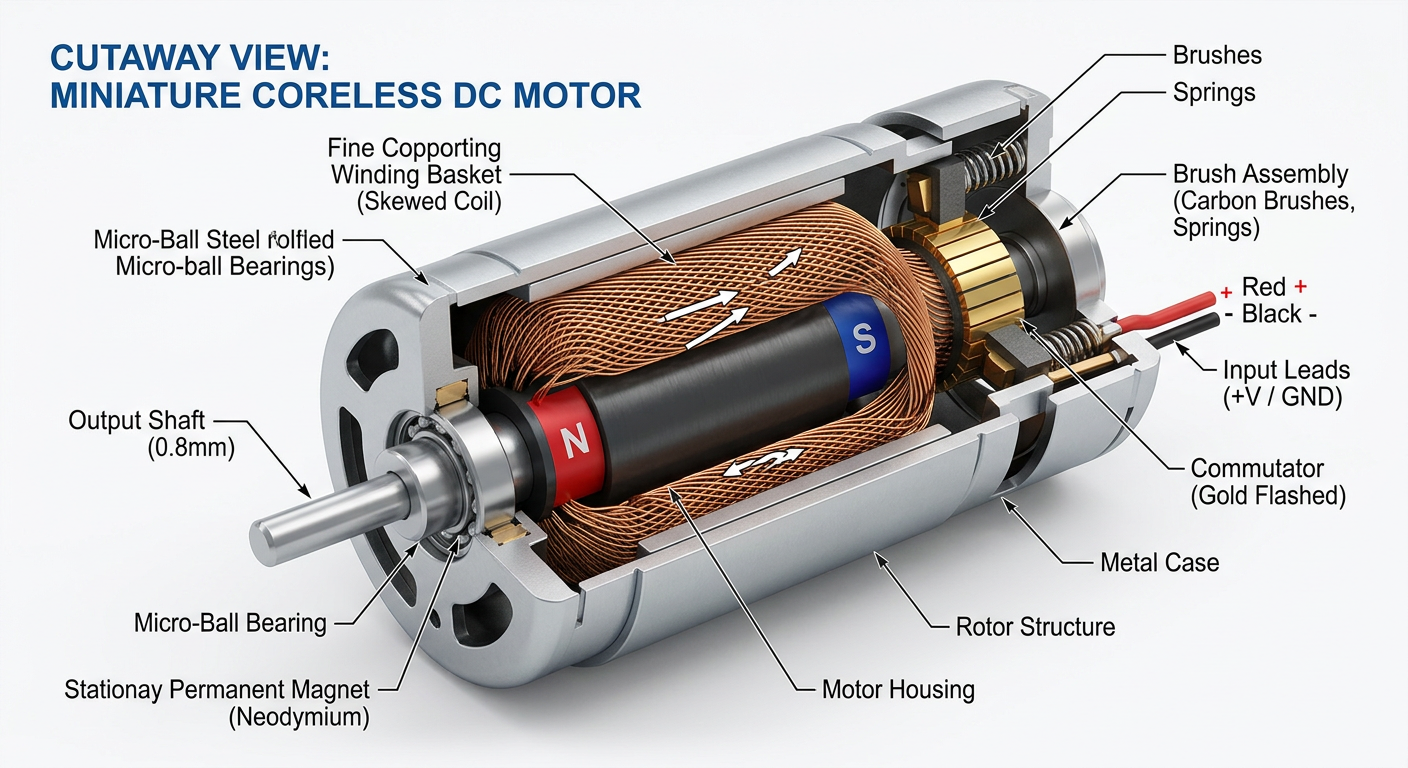
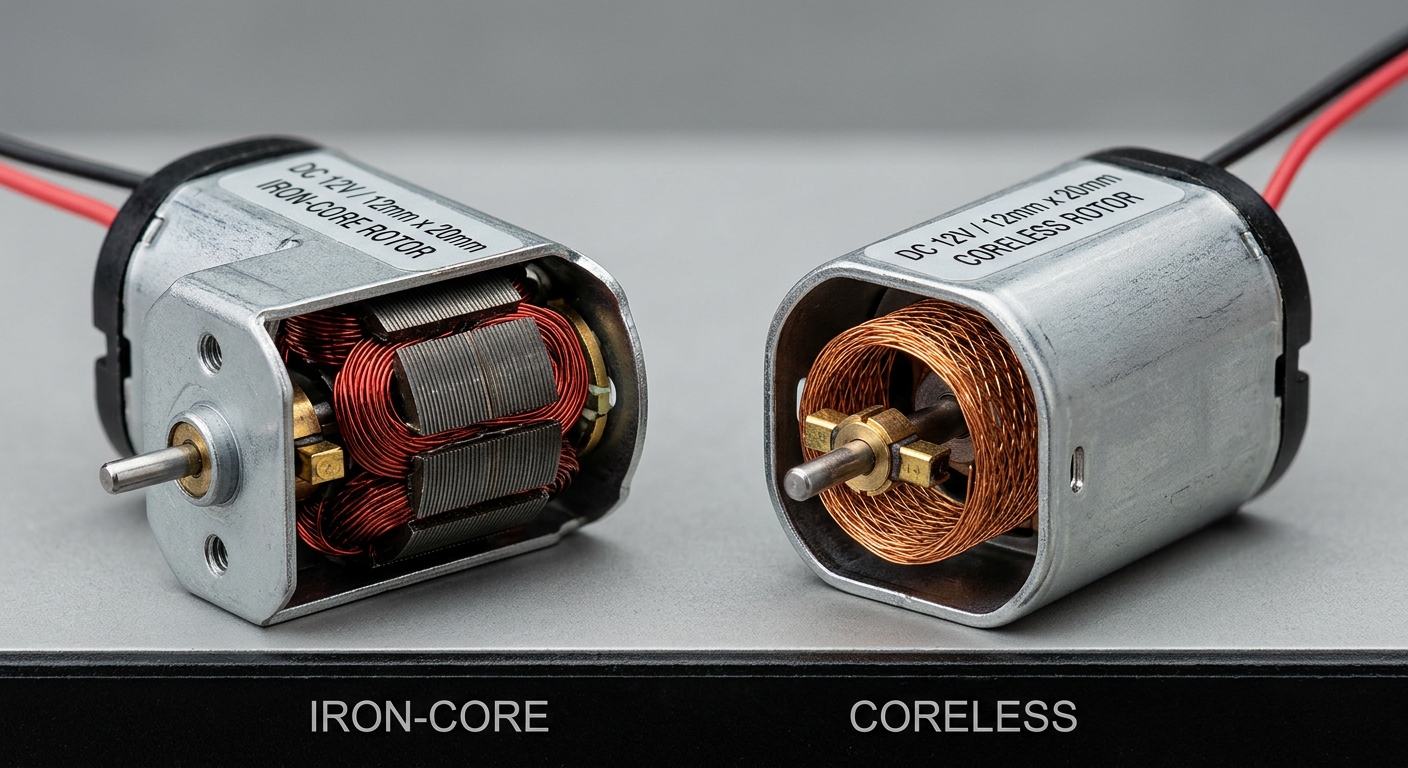
The defining feature is in the rotor. A conventional brushed DC motor wraps copper windings around a laminated iron core, which adds magnetic flux but also adds mass and inductance. A coreless motor throws the iron away entirely. The windings are self-supporting — a hollow, skewed copper basket spinning inside a stationary magnet.
That single design change cascades into every spec sheet number you care about:
- Rotor inertia drops by 3–10x, so the motor accelerates and decelerates almost instantly.
- Cogging torque disappears — there’s no iron to attract the magnets, so rotation is silky-smooth at any speed.
- Electrical time constant shrinks, often below 1 ms, giving you crisp PWM response.
- No-load current is tiny, sometimes a tenth of an equivalent iron-core motor.
That’s the physics. The question is whether your product actually benefits from any of it.
The Four Scenarios Where Coreless Earns Its Price Tag
Skip the marketing copy. Here are the only four reasons engineers actually pay the coreless premium:
1. You need response time under 10 ms
Surgical tools, haptic feedback devices, and pick-and-place grippers can’t tolerate the lag of a heavy iron rotor. If your control loop is updating at 1 kHz and the motor responds at 50 ms, you’re wasting the controller.
2. The product runs on a battery
Coreless motors routinely hit 80%+ efficiency. An iron-core brushed motor at the same size class is often closer to 60%. For a handheld device that needs to last a full shift, that’s the difference between “works all day” and “customer complains.”
3. Noise matters
Cogging torque in iron-core motors creates audible hum and vibration. In a quiet operating room, a sleep apnea device, or a premium consumer product, that hum is unacceptable. Coreless motors run noticeably quieter — often 5–10 dB lower under the same load.
4. You’re driving a precision encoder loop
Smooth rotation without cogging means cleaner position feedback. If you’re trying to hold position to fractions of a degree, the lack of cogging torque makes the controller’s job much easier.
If none of those four apply, you’re probably overspending.
Coreless vs. Iron-Core Brushed: The Honest Comparison
The two look similar from the outside — same 6 mm, 8 mm, 12 mm, 16 mm diameter form factors, same brush-and-commutator construction. Inside, they’re built for very different jobs.
For a deeper look at how brushed, brushless, and coreless families compare across the board, see our complete guide to DC motor types. The short version:
Iron-core brushed motors are the workhorse. They handle continuous duty, tolerate stalls better, and cost a fraction of coreless. They’re the right call for a vending machine actuator, a curtain motor, or a basic peristaltic pump.
Coreless motors are the precision specialist. They’re not designed to survive sustained overload — the windings have no iron heat sink, so thermal margin is thinner. Run a coreless motor at stall for 30 seconds and you’ll often smell it before you see smoke.
Where the Extra Cost Is Wasted
Plenty of products use coreless motors when they shouldn’t. Here’s where I’d push back if a customer asked for one:
- Slow-moving gear-driven mechanisms. If a worm gearbox is already sitting on the output and the load only moves at 30 RPM, the motor’s response time is irrelevant. The gearbox dominates the dynamics.
- Mains-powered devices. Efficiency matters less when you’re plugged into a wall. Save the money.
- Continuous-duty heavy loads. Coreless motors don’t like sustained high torque. An iron-core motor with a planetary gearbox will outlast it in this scenario.
- Cost-sensitive consumer toys. A $0.80 iron-core motor moves the same plastic cam as a $3.50 coreless. No one cares.
For example, a customer once asked us to spec coreless motors for a smart pet feeder dispensing kibble twice a day. The motor runs for two seconds, then sleeps for twelve hours. We talked them into a standard brushed gear motor and saved roughly $4 per unit on a 50,000-unit run. The end user could not tell the difference.
Sizing and Spec’ing a Coreless Motor Correctly
Coreless motors are unforgiving about thermal limits. The rated continuous torque on the datasheet is the real ceiling — not a suggestion. Here’s the spec discipline that keeps them alive:
Stay below 70% of rated current in continuous operation
Because the rotor has no iron to absorb heat, the windings reach thermal limits faster than you’d expect. Build margin in.
Check the maximum permissible speed
Some coreless motors will spin to 20,000+ RPM, but brush life collapses above the rated speed. If you’re gearing down anyway, run the motor in its sweet spot — often 6,000–10,000 RPM.
Match the gearbox carefully
A 6 mm coreless motor paired with a 6 mm planetary gearbox is a beautiful little package, but the gearbox’s maximum input speed must match. Don’t slap a 5,000 RPM-rated gearbox on a motor that wants to spin at 12,000.
If you’re not sure where to start, our breakdown of torque and speed specs to verify before buying walks through the calculation in detail.
Real-World Applications Where Coreless Is the Default
A few markets have effectively standardized on coreless motors because the alternatives can’t keep up:
Medical and battery-powered devices
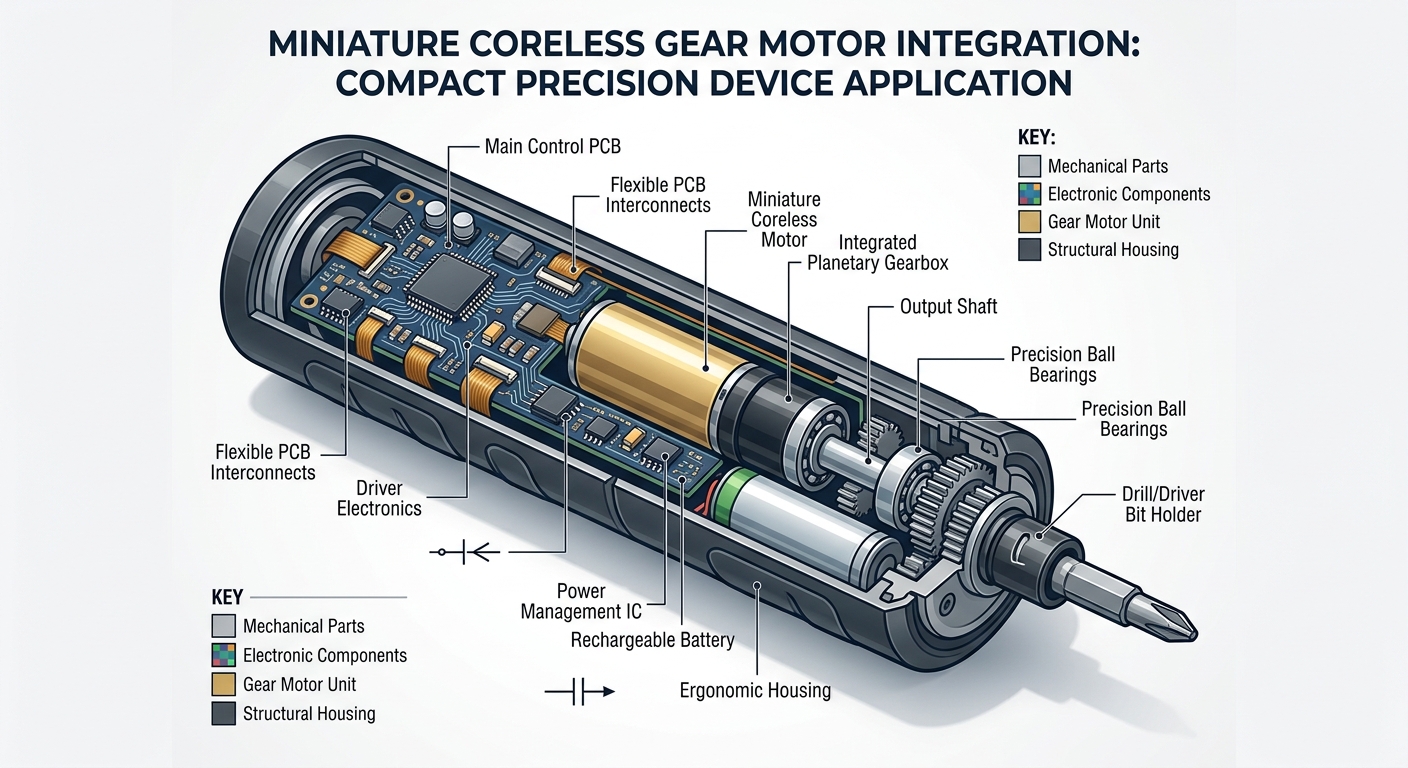
When battery runtime, low vibration, compact size, and precise control are all critical, coreless motors often justify the premium. For a deeper engineering discussion focused specifically on healthcare products, see our guide to coreless DC motors in battery-powered medical devices.
Drones and gimbals
For small camera gimbals and FPV adjustments, coreless motors deliver the response time needed for sub-millisecond corrections. They’re also lighter, which compounds on a flying platform.
Precision robotics and prosthetics
Finger joints in prosthetic hands, micro-robotic grippers, and lab automation pipettes all rely on the smooth low-speed control that only a coreless rotor delivers. Cogging would destroy the control feel.
For instance, an OEM customer building a portable veterinary ultrasound used a 12 mm coreless gear motor to drive the scan head. The earlier iron-core prototype ran hot enough to require a cooling vent — the coreless version eliminated the vent entirely and added 40 minutes to battery life.
The Cost Math: When the Premium Pays Back
Let’s put numbers on it. A typical 12 mm iron-core brushed gear motor lands around $3–6 in OEM volume. The equivalent coreless version runs $10–18. That’s a $7–12 delta per unit.
For that premium to make sense, one of the following has to be true:
- Your product sells for $200+ and the motor is a critical performance differentiator.
- Battery cost or PCB heatsinking would otherwise increase by more than the motor delta.
- Warranty returns from noise complaints or premature failure exceed the savings.
- Your customer specifies medical-grade or aerospace-grade precision and won’t accept lower.
If none of those are true, the spreadsheet doesn’t lie — stick with iron-core. If two or more are true, coreless is almost always the cheaper total-cost-of-ownership choice once you account for downstream effects.
Custom Coreless Configurations Worth Asking About
Off-the-shelf coreless motors cover most needs, but a few customization options are worth knowing:
- Precious metal brushes for low-current, low-noise applications (medical, audio).
- Graphite brushes for higher current and longer life in industrial use.
- Integrated encoders — magnetic or optical — for closed-loop position control.
- Matched planetary or spur gearheads in 6, 8, 10, 12, 16, 22 mm diameters.
- Custom shaft, lead length, and connector for direct OEM drop-in.
If your application has unusual torque-speed requirements or packaging constraints, it’s often cheaper to spec a custom gearhead than to over-design the standard one. We cover the decision logic in our guide on when to choose a custom gearbox over a standard motor.
Making the Right Call for Your Project
The decision comes down to four questions. Does your product need millisecond-class response? Does it run on batteries where every percent of efficiency matters? Will your end user notice noise or vibration? Are you closing a precision control loop with an encoder? If you answered yes to two or more, coreless is the right specification — and the cost premium will look like a bargain once the product ships. If you answered no across the board, save the money and put it into a better gearbox, better bearings, or a longer warranty.
If you’re still on the fence, talk to an applications engineer who has spec’d both. Send us your duty cycle, torque profile, and packaging envelope through our contact page, or browse our compact motor lineup in products to see which form factor fits. Picking the right motor early is dramatically cheaper than redesigning around the wrong one later.